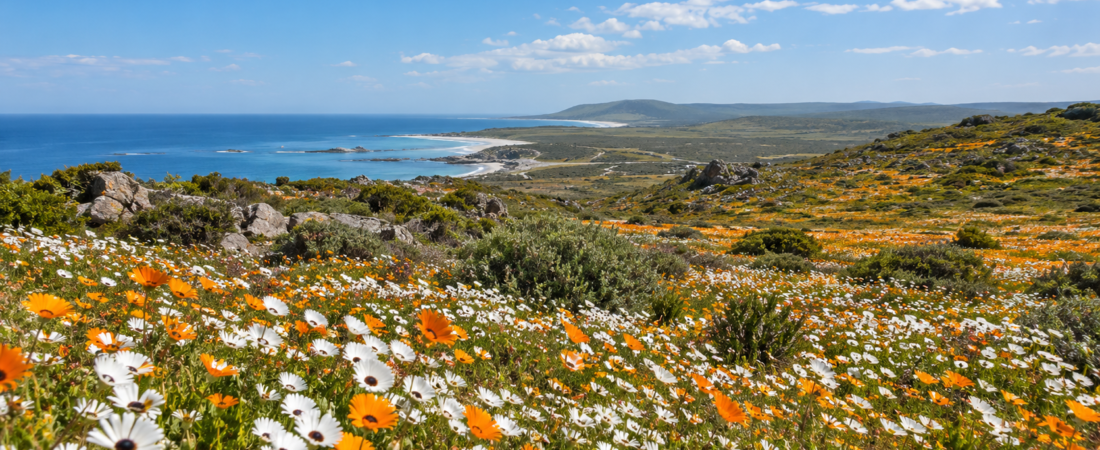
For a few weeks each spring, the usually muted landscape of the Cape West Coast changes dramatically. Fields of orange, white, yellow and purple flowers appear among the fynbos, while the blue of Langebaan Lagoon provides a striking backdrop.
If you want to experience Postberg in 2026, however, there is now a deadline: the seasonal section of West Coast National Park closes to day visitors after 30 September.
Every year, there is a short window when one of the Western Cape’s most memorable natural displays appears along the West Coast.
It is also one of those Cape experiences where timing really matters.
The flowers respond to rainfall, temperature, cloud and sunshine. A field that looks subdued on an overcast morning can look quite different once the sun appears. And unlike most attractions around Cape Town, Postberg cannot simply be postponed until next month.
In 2026, the Postberg section of West Coast National Park is open from 1 August to 30 September. After that, public access closes again until the next flower season. Check the official SANParks flower-season information.
Why Postberg is worth seeing during flower season
West Coast National Park is worth visiting throughout the year for Langebaan Lagoon, coastal landscapes, birdlife, beaches and fynbos.
Spring adds another dimension.
The Postberg section is particularly special because it opens to ordinary day visitors only during the August and September flower season. Depending on conditions, the area can produce broad displays of daisies, bulbs and other indigenous flowering plants. Seeberg, Mooimaak and Postberg are among the park’s notable flower-viewing areas.
The appeal is not simply finding the largest field of flowers. It is the combination of colour, fynbos, wildlife, coastal air and lagoon views — and knowing that the landscape will not look quite like this for another year.
Is late September still worth going?
Yes — but go with realistic expectations.
Flower displays are natural rather than scheduled. Their timing and intensity vary with rainfall, temperature and sunshine, and different species appear at different stages of the season.
SANParks notes that the landscape continues to change as different species come into bloom, so late September should not be approached as a guaranteed “peak” display.
What makes this part of September compelling is that 30 September is the final opportunity to visit Postberg during the 2026 flower season.
Before leaving Cape Town, check the latest official flower updates and the weather forecast. A recent positive flower report combined with a sunny day is a much better reason to make the trip than the calendar alone.
When is the best time to see the flowers?
Sunshine matters.
SANParks advises that flower viewing is generally best on sunny days between late morning and mid-afternoon, when many of the flowers are fully open.
That does not mean you should leave Cape Town at lunchtime.
West Coast National Park becomes extremely popular during flower season, particularly on sunny weekends. SANParks encourages visitors to arrive early and, where possible, choose a weekday rather than a weekend.
A good strategy is therefore to enter the park early, enjoy the drive and lagoon scenery, and position yourself around the main flower-viewing areas from late morning onwards.
How far is West Coast National Park from Cape Town?
West Coast National Park lies roughly 120 km north of central Cape Town, making it very manageable as a day trip.
Allow around 1.5 hours or more each way, depending on where you start, traffic and queues at the park during busy flower-season days.
The important point is not to treat it as a quick there-and-back excursion. This is a trip that works better when you allow the whole day and keep the itinerary relatively simple.
A relaxed flower-season day trip
Early morning: Leave Cape Town
Head north on the R27 and aim to reach West Coast National Park before the flower-viewing period becomes busy.
If you are travelling on a weekend, leaving earlier becomes even more important.
Morning: Explore the wider park
There is no need to race directly to Postberg.
Take in the lagoon, fynbos and landscape as you make your way through the park. Flower viewing is part of the experience rather than the only reason to be there.
Late morning to early afternoon: Make Postberg the focus
This is the period when sunshine is more likely to have opened the flowers.
Drive slowly, use the designated roads and stopping areas, and give yourself time. A flower trip becomes far less enjoyable when it turns into a frantic search for the “best” field.
Lunch: Keep it simple
A picnic works particularly well because it gives you flexibility around weather and flower conditions.
Food and refreshments are also available within the park, including at Geelbek, and a kiosk operates when Postberg is open during flower season.
Afternoon: Lagoon, viewpoints or a coastal extension
Spend more time exploring the park or, if you still have time and energy, continue towards Langebaan.
Do not feel that you have to add another destination simply to make the drive worthwhile. West Coast National Park can easily fill most of the day on its own.
What does it cost to visit in 2026?
During the August–September 2026 flower season, SANParks lists daily conservation fees of:
- South African citizens/residents: R121 per adult and R61 per child aged 2–11
- SADC nationals: R192 per adult and R95 per child
- International visitors: R306 per adult and R153 per child
These rates apply during the current tariff period ending 31 October 2026. Check the latest West Coast National Park entrance fees.
For September, the general park operates from 07:00 to 19:00, with last vehicle entry at 18:30. Postberg’s flower-season hours are 09:00 to 17:00, with last entry at 16:30.
Because operational information can change, check SANParks again shortly before travelling.
What should you take?
You do not need specialist equipment, but a little preparation makes the day easier.
- Water
- Sunscreen
- Hat and sunglasses
- Comfortable shoes
- A light jacket or windbreaker
- Snacks or a picnic
- A charged phone or camera
- Binoculars if you enjoy birding or wildlife
Spring weather on the West Coast can change quickly, so layers are useful even when the morning looks promising.
SANParks also sells a Spring Flowers booklet at the Postberg entrance, helping visitors identify some of the plants they see while supporting conservation initiatives.
Remember that the flowers are protected
The best flower-season visit is one that leaves no trace.
Stay on designated roads and paths, follow SANParks instructions and never pick, trample or drive onto flower-covered areas for a photograph.
There is no need to get into the middle of a field to capture the experience. Some of the strongest views include the wider landscape — flowers in the foreground, fynbos beyond them and the enormous West Coast sky above.
Why now really is the time to go
Cape Town and the Western Cape offer plenty of outings that can be postponed.
Postberg is different.
The 2026 public flower-season access ends on 30 September. The flowers themselves remain dependent on nature, so there is no guarantee that a particular day will deliver exactly the display you have seen online.
But that uncertainty is part of what makes the experience special.
Choose a sunny day if you can. Leave Cape Town early. Keep the itinerary simple. Give yourself time once you arrive.
And if seeing the West Coast flowers has been sitting on your list all season, this is the moment to stop postponing it.